
In Minor Keys, Against the Canon
- Katica Kocsis
- May 20
- 6 min read


The international exhibition of the 61st Venice Biennale, In Minor Keys, asks us to listen to the quieter, deeper artistic voices that Eurocentric art history has kept at the margins for far too long. In Koyo Kouoh’s vision, the intimate, the personal, and the historically marginalized are not secondary or “soft” subjects. They are political terrain. The Biennale does not merely expand the canon; it changes the frequency on which we are asked to listen.
Walking through the exhibition, one has the feeling that something is finally, genuinely shifting. It is time to say it clearly: we have looked at art for far too long through a painfully narrow, Eurocentric lens. This turn was already visible at the previous Biennale, but here it becomes sharper, more radical, less apologetic. The era of that polished, self-satisfied understanding of art — the one that placed the white male artist at the top and measured everyone else against him — seems, at last, to be losing its authority.
Koyo Kouoh’s curatorial vision goes straight at this hierarchy. The exhibition is not interested in building a new centre from which art history can be explained again. It asks a more uncomfortable question: why should there be a centre in the first place? Cultures, rituals, memories and ways of knowing are brought into proximity without being translated, disciplined or made palatable for a Western gaze.

Here, art does not arrive in clean categories. It comes with colour, smell, spirit, body and matter. The exhibition refuses the old, exhausted divisions between high and low, centre and periphery, canon and craft. These voices are not arranged as a polite multicultural chorus. They are allowed to stand beside one another with their tensions, contradictions and unresolved edges still visible.
Kouoh brings into view artistic practices that art history has long misread, patronized, exoticized, or simply ignored. Crucially, she does not correct this through another exoticizing gesture. Artists from Africa, South America, Australia, and elsewhere do not appear here as colorful additions to a Western story. They appear as fully formed artistic worlds — not exceptions waiting to be explained by Europe. The exhibition does not over-explain them. It does not tame them. It does not flatten their differences into a polite multicultural display. It lets them speak.
From the beginning, In Minor Keys demands another kind of attention. Our habitual art-historical reflexes do not take us very far here. The need to classify quickly, interpret from above, and place everything into safe categories has to be left at the entrance. Khaled Sabsabi’s monumental installation, the opening work of the Arsenale, performs precisely this shift. It retunes the visitor on a sensory level. We enter a space where the body understands before the mind has time to classify; where spirituality, sound, presence, and sensation come before explanation.

One of the strongest experiences of the exhibition is the radical return of materiality. In a flat, cold world saturated with digital images, there is something almost liberating in encountering works that have weight, texture, smell, surface, and physical insistence. Sensual, tactile works follow one another in dense succession. Reception here does not happen only through the eyes. The skin is involved. At times, even the nose. Perhaps we should leave the tongue out of it — artworks are still not meant to be licked — but the desire to touch remains present throughout these rooms.
On the monumental, hairy, concrete-like layered canvases of Kenyan artist Kaloki Nyamai, paint and textile together trace the scenes. Puerto Rican artist Daniel Lind-Ramos creates guardian-like, totemic figures from industrial objects and materials scattered in the aftermath of hurricanes. American artist Kennedy Yanko also works through the transformation of industrial materials: in her hands, hard, heavy metal becomes unexpectedly soft, almost painterly. Zimbabwean artist Georgina Maxim builds intimate, personal spaces from small, meaning-laden fragments and textiles, where different threads of memory begin to draw out the story of a community.

Another important layer of the exhibition is its refusal of grand, universal narratives. Instead of one large, supposedly neutral story, we encounter histories told from close range. The exhibition shows the power of someone speaking from within their own culture, community, and personal experience — without asking permission from the canon.
Refaat Alareer’s poem beautifully introduces this emphasis in "If I Must Die," which speaks not only of loss but of the elemental human desire for something to remain after death: a story that can still be told, passed on, and carried further.

In Edouard Duval-Carrié’s works, Haitian history does not speak through official archives, but through the spirits of vodou. His figures are not folkloric scenery. They carry the histories of slavery, revolution, migration and collective survival. Ayrson Heráclito starts from the world of Candomblé, but rather than illustrating it, he shows how Afro-Brazilian religious knowledge can be reactivated and rethought. Tuấn Andrew Nguyễn, through the figure of Bouba Chinois, unfolds one of the forgotten side stories of colonial history, where vast geopolitical movements condense into the fate of a single person.
The works on view are also deeply spiritual. Dreams, rituals, ancestors, and natural and cosmic forces do not appear as something added to everyday life from the outside. They already ran through it. Werewere Liking’s dreamlike paintings on bark, Seyni Awa Camara’s clay beings suspended between human and animal, Kaamubji Olujimi’s gravity-defying figures, and the hybrid, mythical female figures of Rajni Perera and Marigold Santos all open onto a reality wider than the one Western art history has usually allowed itself to name.
Nicolas Hlobo’s Umrhubuluzi, a humanoid figure sewn from leather, is distinctly unsettling. It evokes the seductive world of mermaids, sirens, and aquatic beings, while the body slips between human, animal, and mythical states. It is impossible to decide where it belongs — and this is exactly where its force lies.
At the same time, the exhibition does not dissolve the world into pure spirituality or sensuality. It does not turn away from the most brutal fractures of the present. Many works respond directly to war, migration, racism, xenophobia, body politics, and the broken relationship between human beings and the earth.
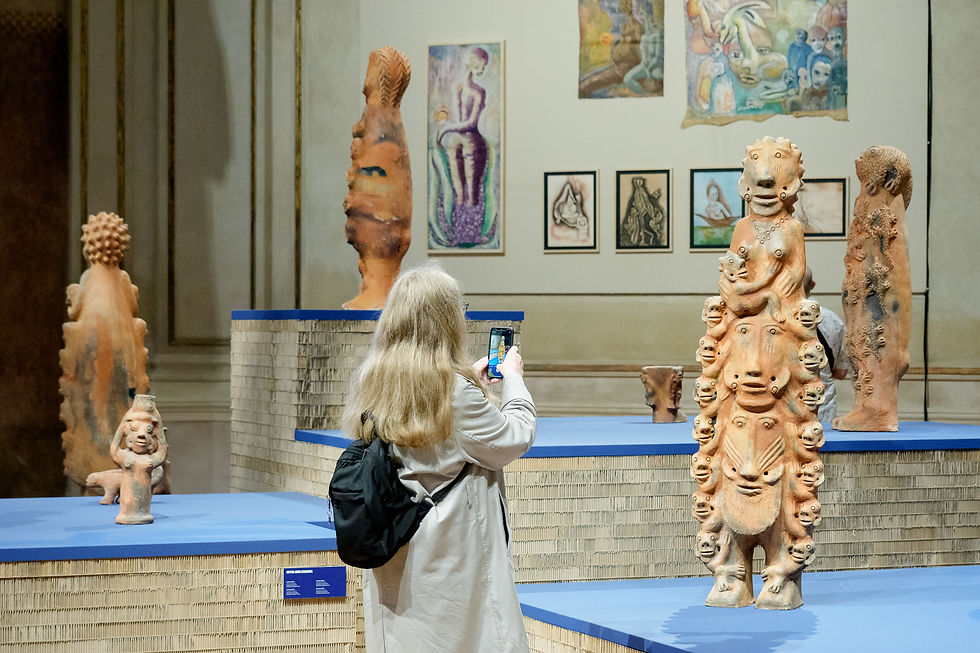
One larger section of the Arsenale, for example, rethinks humanity’s place in the world through geological, ecologica,l and planetary questions. At the same time, other works bring the concrete consequences of political violence painfully close. At one moment we are balancing on the threshold between reality and mysticism; at the next, we are pulled mercilessly back into the present.
In both the Giardini and the Arsenale, we encounter dense, sensual and extraordinarily rich material. Still, there are moments when the rhythm of the exhibition breaks and the line of thought becomes more diffuse. This is clearly connected to the fact that after Kouoh’s death, the final form of the exhibition had to be shaped by the curatorial team. At times, this is unsettling. At other moments, it can be read as a continuation of the exhibition’s receptive, non-hierarchical logic.

What is harder to forgive, however, is the quality of several accompanying texts. In an exhibition this complex, culturally loaded and historically layered, wall texts should not function as decorative mist. They should do real work. They should help the viewer understand what is at stake.
Too often, instead, we get beautiful, safe, AI-scented sentences. The writing remains cautious and polished, saying a great deal without really taking responsibility for a clear interpretation. One reads these texts and still does not quite know why the work matters, what history it carries, or what kind of knowledge it is asking us to confront.
This is especially frustrating because In Minor Keys sets out to give space to stories we have not heard for long enough, have not learned to read, or have simply refused to take seriously. What is needed here is not floating curatorial language, but precise, brave, interpretive writing. Texts that are willing to say where a work comes from, what knowledge it carries, what context it speaks from, and why it matters.

At certain points, the exhibition itself is simply too crowded. One understands the impulse: after so many histories have been pushed aside, there is a powerful urge to make room for as many of them as possible. But generosity is not always the same as clarity. Some works would need more space, more silence, more time around them. Placed so tightly together, they occasionally start to cancel each other out.
And yet the experience does not collapse. There are so many powerful works in the selection that once one gives up the desire to understand, organize, and possess everything equally, it becomes genuinely rewarding to surrender to this lush, overflowing material.
Perhaps this is also one of the most important lessons of In Minor Keys: not everything needs to be mastered, decoded, and put in order. Sometimes it is enough to hear what has been sounding all along — we simply had not been listening for far too long.


Comments