
Shalom Kufakwatenzi: God can communicate through me
- Katica Kocsis
- 2 hours ago
- 11 min read

In Shalom Kufakwatenzi’s practice, textile, fashion, music, and performance are not separate disciplines. But different manifestations of the same energy. The Harare-based artist spoke about childhood loneliness, searching for and redefining identity, returning to her Christian faith, and the challenges of sustaining an artistic practice in Zimbabwe.

You moved several times during your childhood, from Murewha to Westgate and from Westgate to Snake Park. What kind of environments did you grow up in?
I grew up in Murehwa until grade four, then moved to Waterfalls to stay with my grandparents. It was a major change: I went from a lively mission-school community to being the only child in a house full of adults, with no one to play with. As a child I sometimes experienced that loneliness as rejection.
Both of my parents are teachers, so I grew up in a strict, disciplined household. When they later moved to Harare, I found community again through school, church and the neighbourhood. By then, however, I had become quite reserved and being the only girl in my family didnt make any better.
How did creativity emerge within that environment?
My mother worked as a part-time dressmaker, and she taught me how to sew, knit, and crochet. For a long time, I never really used those skills. They were simply things I knew how to do. Later, when I began making art, they returned.
Originally, I wanted to become a fashion designer. In high school, I studied fashion and fabrics, but I was also very interested in visual art and music. Even then, the three areas that remain connected in my work today were already present.
After high school, I wanted to continue studying fashion, but I did not have all the subjects required for admission. That was when my father took me to the National Gallery of Zimbabwe. I first attended Sunday art courses and was later enrolled at the National Gallery School of Visual Arts and Design. We studied several disciplines, but I eventually specialized in sculpture and photography.
In art school, I completely fell in love with visual art, and fashion moved into the background for a while. Later, I realized that I did not actually have to choose between them. I could use textiles in installations and sculptural works, so my relationship with fashion and materials returned in another form.

Although your practice includes installation, photography, video and performance, textile is present in almost everything you make. Why has it become so central?
Visual art using textile is my primary medium. The act of joining things together is very important to me.
I am also someone who likes fixing things, putting things together, and, whenever possible, helping other people.
That is where the significance of sewing and repair comes from in my work. I am trying to reshape or restore something. I believe it is linked to the fact that growing up i always thought i was not good enough because i would constantly be compared to other kids, especially my cousins. So the idea of being a perfectionist was driven by insecurities from my childhood and has grown into a skill to do things with excellence.
What is your relationship with hessian, which appears very often in your work?
In Zimbabwe, it is used, among other things, to wrap tobacco. I was drawn to its roughness, its strong texture, and its durability. It can carry an enormous amount of weight, yet it is often treated as worthless and discarded.
When I began using it, it was not as accepted in fashion or interior design as it is today. Other people saw an insignificant, worn-out material, but I could see its beauty. I think I related to it personally as well. As a child, I often felt misunderstood, and for a long time I believed I was not good enough.
I carried a lot of insecurity, which later developed into depression and anxiety.
After enrolling in art school, I began to feel recognized for the first time. Art gave me confidence, identity, and a community. It gave me a voice. Because of that, the story of an underestimated and discarded material felt very close to my own.
You connect sewing with repair, and art partly with healing. How do you understand the purpose of art today?
When I first began making art, I thought of it primarily as a means of self-expression. I wanted to become visible. But as I changed as a person, I realized that art is not only about the artist. It can be used to communicate, to help people, and it can genuinely become part of a healing process. Today, I think of myself as a kind of vessel. God can communicate through me, and I have a responsibility to share that message with the world.
Fabric is often described as malleable and transformative in your work. What does this flexibility mean to you?
I do not like things to be confined to a box. The traditional approach, where a work is placed inside a frame and then expected to exist in exactly the same way forever, feels very distant from me. Things grow, expand, and transform. Life is like that too. A butterfly begins as a caterpillar, then enters a cocoon, and eventually becomes something entirely different. Something I explored in my first solo Exhibition in 2024: The cacoon a Be-you-till-full Place.
I want my works to be able to grow, move, and speak as we move, change, and learn new things. I want to give my works that same freedom.
How does a new work usually begin for you?
Honestly, sometimes I do not know where an idea comes from. I like to think that God places the desire to create within us. God is a creator, and because he created us, something of that creative force also exists within us as Artists.
Sometimes a work feels like a memory or a vision. I sometimes make sketches, especially when I am thinking about a series, but generally I do not like to determine the final result too precisely in advance. I prefer to allow the material to give me direction, more like a conversation.
Sometimes I see a piece of fabric and immediately know what I could do with it. While I am working, one decision leads to the next, and the finished piece may then give birth to another work. I am not always the one directing the material. Very often, the material directs me.

How do music and singing connect to your visual practice?
For me, they are not separate. They are different parts of the same creativity that God gave me. When I get stuck in one area, doing something else often helps the energy flow again.
When I do not play the piano, sing, or make art for a long time, I feel as though I am starving one part of myself. Some kind of internal connection is broken. Music, fashion, dance, and visual art are intertwined within me.
What is it like to live and work as an artist in Harare today?
Recently, there has been a great deal of instability within the Zimbabwean art scene. There are fewer sales, and it is difficult to make a predictable living. At the same time, my faith gives me hope. As an artist, however, you also have to be practical. It is not enough simply to create and wait. I teach art, for example, and I have also started an Accessory brand called AmaNi. You need other activities to support your artistic practice, because not everyone can survive solely on selling artworks.
Your works begin with deeply personal experiences, but they also speak about the community around you. How do these two levels connect?
Most of my work is about identity, faith, and the things happening around me. My work begins with me, but it does not end with me. It is like a book or a film: there may be one main character, but other people live around them, and other stories are also unfolding. I speak about my own journey, but also about what I see in others, what I experience within my community, and the struggles of the people around me.
Your work has previously been interpreted through the lens of your queer identity and your experience as an outsider. How do you speak about that period of your life today?
I previously identified as queer. The loneliness of my childhood, being reserved and feeling that other people did not understand me were all part of the way I searched for myself at the time. In the Tutundu series, I was also trying to process that: to understand who I was, what burdens I carried, and why I felt like an outsider in certain situations.
Now I am going through another transformation. I eventually returned to Christianity because I feel that God called me back. Today, I believe different things than I did before, so I am relearning and redefining myself. I am moving away from the identity and the views I previously represented. I am surrounded by a different community, and my work is also changing. But it is still part of the same journey.

Your work Mubatanidzwa (Adjoined) deals with the political issue of land distribution in Zimbabwe. How did the work emerge?
I do not consider myself an explicitly political artist, and I generally do not like speaking directly about politics. But Mubatanidzwa is a political work.
In my area, there are many newly allocated residential stands, and houses are constantly being built. You often hear stories about the same stand being sold to several people. Someone buys a piece of land, only to discover that another person also legally claims to own it. Then everyone has to fight to prove their rights, or they try to share the same space somehow. The work grew out of those situations. It is about how people try to create balance within an already unjust system. More broadly, it also contains the story of land distribution, displacement, and corruption in Zimbabwe.
Earlier works were dominated by neutral, earthy tones, but later intense colors appeared in your practice. What caused that change?
For a long time, I worked with the natural colors of hessian, so the pieces were more subdued. I began experimenting seriously with color around 2022, during my residency at Animal Farm, when I started working with wool, yarn, and other colorful materials.
At the time, I was also teaching children. They expressed themselves very freely and directly, and they were not afraid of color. That took me back to my own childhood and encouraged me to become more playful with color as well.
The Everything Coming Up Colorful series emerged from this period. The colors are therefore not simply decorative. They represent an opening, a liberation, and the beginning of a new life.
Early in your career, you also created a collaborative work with Troy Makaza. How did Paivapo (Once Upon a Time) come about?
After art school, Moffat Takadiwa, Troy Makaza, and the artists around them welcomed me into the studio environment they were using at the time. Troy and I spoke a lot, and at one point we simply decided to create something together. We were both interested in how materials that would not usually be associated with one another might behave when combined. We connected the hessian and textile I was using with Troy’s paint-infused silicone not knowing in advance whether the materials would even hold together.
The work also had a political layer, which connected more strongly to Troy’s practice. For me, however, the material experiment and the encounter between our energies were central. Two different backgrounds, two ways of thinking, and two approaches to material came together in the work.

To what extent do artists have to set aside their own ideas, or even their ego, when collaborating?
Collaboration is a learning process based on exchanging ideas, methods, and experiences. It requires setting aside some of your ego and remaining open to another person’s perspective. It can also connect artists at different stages of their careers, allowing both to learn from each other. The best collaborations are genuinely reciprocal.
In 2024, Under the Sea and Mubatanidzwa were included in the international exhibition of the Venice Biennale. How did you experience that moment?
It was completely unexpected. I was simply working on my own projects, and I had no idea that an opportunity like that would arise. I experienced it as God opening a door for me, and I am deeply grateful.
Under the Sea was created during the period of Everything Coming Up Colorful, while Mubatanidzwa emerged from experiences related to land distribution. These two works, which are different yet connected, were selected for the Biennale.
It was an extremely important moment because it gave me international visibility. People encountered my practice who might otherwise never have seen it. One of the works was collected at the Sao Paulo Museum in Brazil, so its story did not end with the Biennale.

After such a major international achievement, what does success mean to you?
The meaning of success depends on what a person values. Some people see only major accomplishments as success. I think every genuine achievement can be understood as a form of success.
The Venice Biennale was a huge step, but you cannot stop afterwards. There is always something new to move towards.
Artists generally do not retire. We continue creating, searching, and trying to reach new opportunities and new heights.
Art also does not expire. A work can continue speaking after its creator is no longer present. perhaps you can say that this is one of the most recognised form of success in the Art Industry: creating something that outlives us and continues to connect with people.
Alongside your visual works, you also create performances. Do you experience these as different kinds of artistic situations?
I do not feel that they can be sharply separated. When I do not perform for a long time, I feel as though I am not feeding one part of my creativity. Performance and object-making use different channels, but they come from the same source. For me, the main question is not which medium I use, but what I want to communicate through it.
In performance, however, your body itself becomes the medium. Does that require courage?
It definitely requires courage. As a child, I was very quiet and found it difficult to speak in front of other people. Art gradually brought me out of that state. At some point, the people around me especially in Dance school, they indirectly asked "When did you start talking so much?"
Within the art world, I had to learn how to communicate, stand in front of people and articulate what I was doing. Dance helped me enormously. I studied as a professional dancer for around three years. As a performer, I had to be present. I could not hide up to date as a performance Art Artist and Professional Dancer.
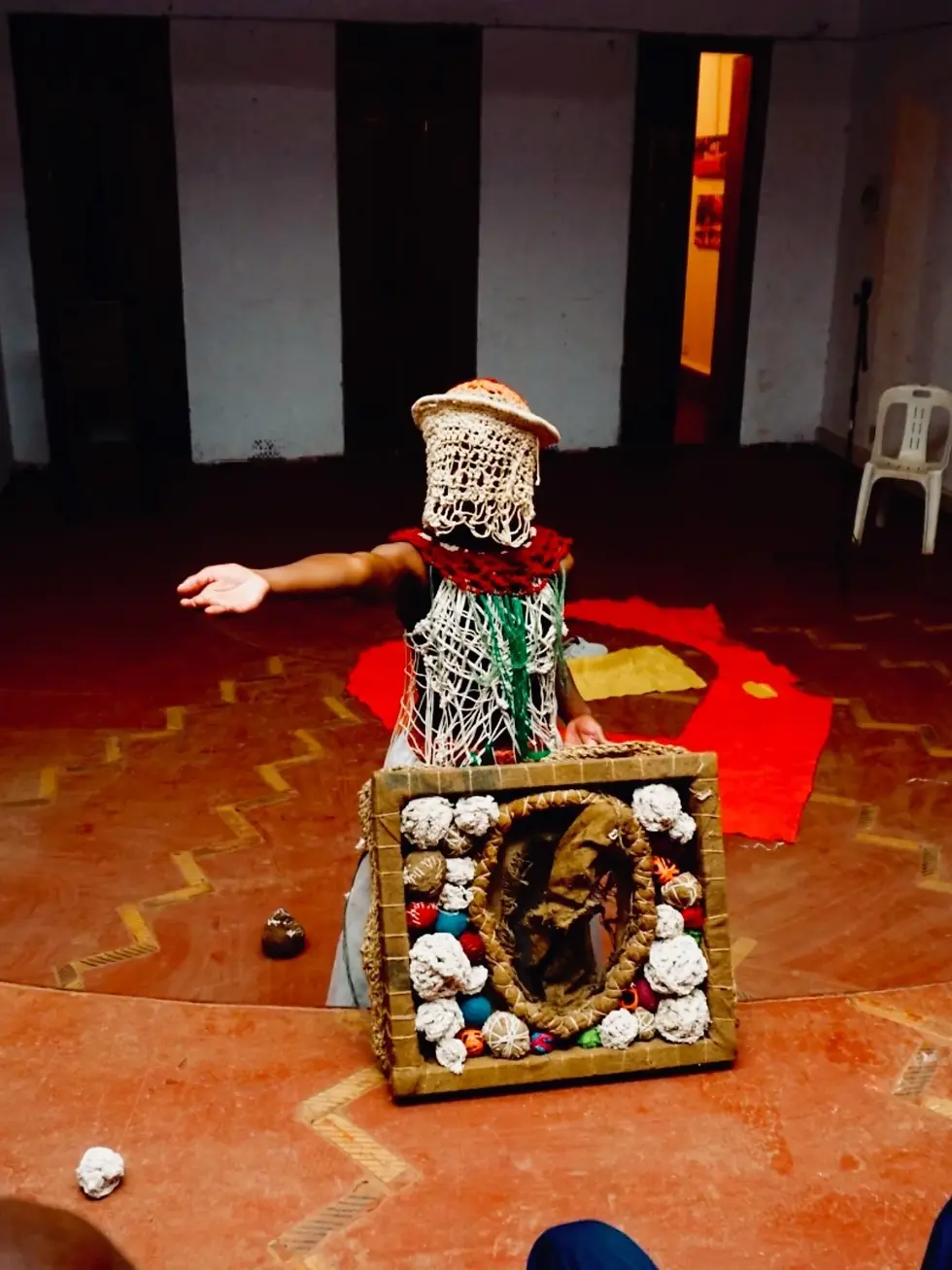
In November 2025, you presented the performance Zivo Chipo at an anniversary event at Nhaka Gallery. What was at the center of the work?
Zivo Chipo is still a work in progress. In the title, zivo means knowledge and chipo means gift. Knowledge is a gift. When you carry knowledge or a gift within you, you carry light and can share that light with others. When you give it away, however, the other person also gives something back. A reciprocal exchange takes place.
During the performance, I held different objects that represented light as a kind of currency. I gave them to members of the audience, and they gave something back to me. It could be knowledge, an Idea, a resource, attention, or another kind of gift.
The performance explores the idea that knowledge is not a static possession. It moves between people. We can give from it, and in the process, we also receive and grow.
Can you reveal what you are currently working on?
It focuses on men’s mental health. In my environment, I am seeing an increasing number of cases in which men struggle with serious mental health problems or die by suicide, yet we do not speak enough about what is happening to them.
A great deal of important work has been done to support and empower women, and that work was necessary. At the same time, I feel that we now need to create a new balance within society and give space to men’s experiences as well. For me, gender equality has to genuinely mean equality.


Comments